Sex
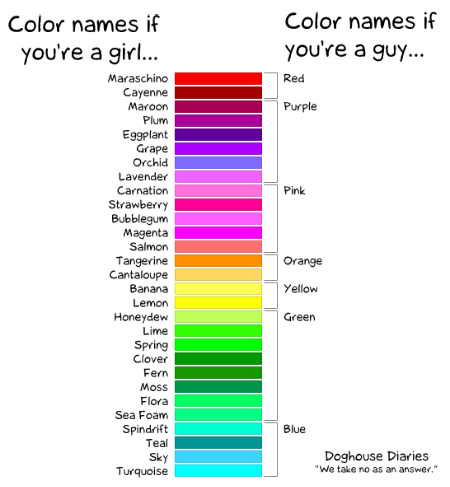
By a strange coincidence, the same night I first made the color survey public, the webcomic Doghouse Diaries put up this comic (which I altered slightly to fit in this blog, click for original):
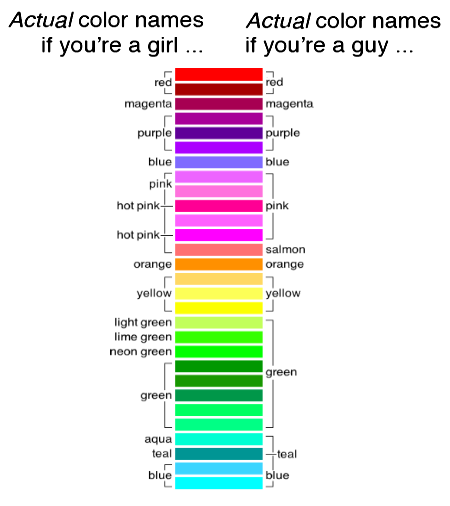
It was funny, but I realized I could test whether it was accurate (as far as chromosomal sex goes, anyway, which we asked about because it’s tied to colorblindness) [Note: For more on this distinction, see my follow-up post]. After the survey closed, I generated a version of the Doghouse Diaries comic with actual data, using the most frequent color name for the handful of colors in the survey closest to the ones in the comic:
Basically, women were slightly more liberal with the modifiers, but otherwise they generally agreed (and some of the differences may be sampling noise). The results were similar across the survey—men and women tended on average to call colors the same names.
So I was feeling pretty good about equality. Then I decided to calculate the ‘most masculine’ and ‘most feminine’ colors. I was looking for the color names most disproportionately popular among each group; that is, the names that the most women came up with compared to the fewest men (or vice versa).
Here are the color names most disproportionately popular among women:
Okay, pretty flowery, certainly. Kind of an incense-bomb-set-off-in-a-Bed-Bath-&-Beyond vibe. Well, let’s take a look at the other list.
- Dusty Teal
- Blush Pink
- Dusty Lavender
- Butter Yellow
- Dusky Rose
Here are the color names most disproportionately popular among men:
I … that’s not my typo in #5—the only actual color in the list really is a misspelling of “beige”. And keep in mind, this is based on the number of unique people who answered the color, not the number of times they typed it. This isn’t just the effect of a couple spammers. In fact, this is after the spamfilter.
- Penis
- Gay
- WTF
- Dunno
- Baige
The above is an excerpt from the blog http://blag.xkcd.com/
The author of the blog carried out a colour survey where the people surveyed were to name colours and gender differences in naming colours was discovered. I came across this blog post before i read Lakoff 's article and thought it was applicable to the discussion as well as interesting. While this survey is not of the academic sort, it does show that gender differences in usage of language is prevalent.
The above blog post not only emphasizes Lakoff's point on women making more precise discriminations, but also the higher likelihood for men to use expletives. In the above case, the people surveyed were made to name a very large number of colours that most of them became frustrated and many men resorted to vulgar language when they gave up naming colours.
I agree especially with the point on the differences in use of swear words by women and men. Men are more likely to use stronger swear words and expletives than women. Although this is changing in the modern society as Lakoff mentioned, I do feel that in the more conservative society in Singapore, many women still use weaker swear words than men. While women using stronger swear words are becoming more common, many male friends of mine have often mentioned that this is 'unladylike' or unbecoming of a woman. These females who are 'unladylike' due to their usage of stronger swear words are then less likely to attract conservative men as a partner. These men tend to look for women that are gentle and caring instead. While the usage of expletives or swear words doesn't necessarily make one less gentle and caring, it seems to conservative men that such women appear not to the 'traditional female' roles of caring and nurturing as well.
Food for thought:
Why is it considered more feminine to make more precise colour descriptions?
How does using stronger swear words come across as more masculine? Is it because it is more aggressive?
What other reactions would men have in response to a women using strong swear words in the workplace as compared to in other social settings?
