Saturday, April 9, 2011

Don'ts for Wives and Husbands


I got these two tiny handbooks when i was on holiday in scotland in some obscure souvenir shop in the middle of some old highland battlefield. Just rediscovered them on my shelf today and thought i'd share some of the interesting bits of these books.

These two books were apparently written by a woman in 1913 and they republished it from a copy from the british library. For a woman in those times, the writer has incredibly modern thoughts despite conforming to social stereotypes of being a nuturer and caregiver as a traditional wife.

DON'TS FOR HUSBANDS:
-Don't fail to treat your wife with respect. Let there be nothing of the high and mighty suggestion that a mere woman can't possibly unerstand things. There are even realms in which you can look up to her as owning superior knowledge, and there are none in which she is to be despised.

-Don't talk down to your wife. She has as much intelligence as your colleague at the office ; she lacks only the opportunity.

-Don't say a married woman doesn't want to go back to school because your wife wishes to attend language classes or lectures, or take lessons in singing and dancing. Let her do any or all of these things, and be thankful that she finds so much that interests her. She will be a much brighter companion than a stick-at-home wife.

DONTS FOR WIVES:

-Don't let your husband feel that you are a 'dear little woman', but no good intellectually. If you find yourself getting stale, wake up your brain. Let there be nothing your husband can talk about that you will be unable to understand

-Don't be talked down by your husband when you want to express your views on any subject. You have a right to be heard


For a woman of that time, the author must have been rather enlighted on gender equality as well as intelligent and well educated in order to write this book. Although many don'ts that she wrote about appear trivial, they are in fact many of the obstacles that couples face in life. Furthermore, her corresponding books for both men and women strive to make both genders work hard at their relationship, instead of women being burdened by the task of improving communication.

Aside from the more serious 'don'ts' posted above, here are some of the others just for humour's sake.

-for husbands: don't scowl or look severe. cultivate a pleasant expression if nature hasn't blessed you with one

-for husbands: don't omit to cultivate a sense of humour. It will carry you safely past many a danger-signal at home.

-for wives: don't expect your husband to be an angel. You would get very tired of him if he were.

Tuesday, March 8, 2011

The best of Singaporean men and the worst of Singaporean women

Found this interesting article online in response to Prof's article on Singaporean men!
http://www.divaasia.com/article/4913

As compared to the article on Singaporean men, this article that I've found is rather extreme in placing men in an incredibly good light and women in the opposite. The author, understandably a man, openly calls Singaporean women 'bitches' and criticizes them. As a female myself, I feel the strong need to defend my own gender after reading this article due to his warped viewpoint.

I feel that numerous flaws in Singaporean women that he pointed out were unwarranted. Sarong Party Girls (SPG) that go after Caucasian men are very much the small minority in Singapore. It is also interesting to note that in the comparison between the two articles, one complains that women in Singapore are expected to be submissive while the other thinks the submissive Singaporean women are boring. How can one win in this situation? This is one of the numerous cases where women are faulted no matter what they do. Another often mentioned case is where female leaders are accused of being heartless when they lead in a more aggressive 'masculine' manner, but yet are said to be bad leaders when they show their emotions. I also feel that the author of the article I posted above has mentioned numerous untruths and biased viewpoints on women. Just as an example, the author has accused Singaporean women of not caring for their appearances once they are attached. On the contrary among almost all of my friends, I have seen the males piling on the pounds once they have a girlfriend for some time and losing weight the moment they are single. Many of the females stay around the same size regardless of relationship status.

On the flip side, Singaporean males have much more flaws that being homophobic and Singaporean women have many other virtues unlike what the author described. Much of the problems that people always complain of Singaporean men and women are due to the society's influences that shape the way people think and I feel that neither gender is better or worse than the other. However, I am after all a female and I can't help defending my own gender :) That said, I don't think Singaporean men are as bad as they seem in the article that the Prof posted.

Sunday, February 20, 2011


FEMININITY
From the Walt Disney film "Summer Magic" (1963)
(Robert B. Sherman & Richard M. Sherman)

Hayley Mills, Deborah Walley & Wendy Turner (Film Soundtrack) - 1963

HAYLEY:
You must walk feminine
Talk feminine
Smile and beguile feminine
Utilize your femininity
That's what every girl should know
If she wants to catch a beau

Dance feminine
Glance feminine
Act shy and sigh feminine
Compliment his masculinity
That's what every girl should know
If she wants to catch a beau

DEBORAH:
Let him do the talking
Med adore good listeners
HAYLEY:
Laugh, but not loudly (Haha)
If he should choose to tell a joke
Be radiant
DEBORAH:
But delicate
BOTH:
Memorize the rules of etiquette
Be demure, sweet and pure
Hide the real you

BOTH:
You must look feminine
Dress feminine
You're at your best feminine
Emphasize your femininity
That's what every girl should know
WENDY:
Femininity, femininity
ALL:
That's the way to catch a beau
 

I find this video particularly pertinent to our discussion on Assignment 2 and the idea of 'femininity'. While this video is rather dated, it gives us an idea of how the society back then expected women to give in to men's power. While these views are not actively promoted in society nowadays, many of these expectations of women still hold, such as not laughing too loudly, walking in a 'feminine' way and complimenting 'masculine' behaviour in order to be able to attract men. One also needs to 'hide the real you' as mentioned in the song in order for men to be attracted to you.

I feel that it is somewhat hypocritical that society is not openly allowed to promote this viewpoint, as there would be much social backlash should someone do so, yet the society still expects such behaviour of women. Just a typical example was when a male friend of mine chided me for not 'sitting properly' as i was tired and was slouching and propping up my legs up on a chair (I was wearing jeans). Another male friend was doing the same thing at that time but it was acceptable for him to do that while it was not for me. Such issues are very much still the 'elephant in the room that nobody notices'.

Tootsie!

It has been some time since we viewed the movie 'Tootsie' in class but some thoughts from the movie still stick with me. What struck me was that Michael, a man masquerading as a woman showed typically 'masculine' traits, in being more outspoken, in control and not allowing men to take advantage of him as Dorothy, and yet many typically 'masculine' men were attracted to Dorothy. The popular media and society often tells women that they should not exhibit such 'masculine' traits for fear of scaring away men and looking unattractive. Yet, Dorothy who exhibits these qualities was considered incredibly attractive by several men who adhere to gender stereotypes. Why do these men who have power and authority fall for a women who is challenging their status?

Another issue I would like to question is how would the women who looked up to Dorothy as an idol react when they found out that it had been a man who was telling them to stand up for themselves all along? Would they feel insulted that it had to take a man to teach someone how to stand up for themselves and challenge the status quo? Or would these women be appreciative of the fact that Michael had stood up for them as Dorothy despite being a man himself? Furthermore, what would the male audience think? If they viewed her as a refreshing change from the typically submissive roles that females played on TV, how would they view the situation now knowing that Dorothy was actually Michael, a man? Would they still be attracted at the qualities that Dorothy possessed and wish for a woman like Dorothy?

Just some thoughts on the movie even though it was a while ago :)

Tuesday, February 8, 2011

Gender Translators

edit: oops. apparently there is some copyright issue and i can't post the cartoons here. but here is the link : http://offthemark.com/search-results/key/gender+differences/

Just two cartoons on gender communication that i find funny. Sometimes I wonder what life would be like if we really do have such gender translators. I sometimes find myself acting like the stereotypical female and flaring up like the woman in the first cartoon for minor reasons, but many times i don't even know why I act and say the things i say at that moment. It is usually after some reflection that i realised what bothered me to make me flare up. Thus, I wonder what life would be like if we knew all these underlying meanings at the moment itself. Does everyone else not know what they 'really mean' when in circumstances like the above?

Sunday, January 23, 2011

Colour descriptions and Swearing (excerpt from xkcd)

Sex
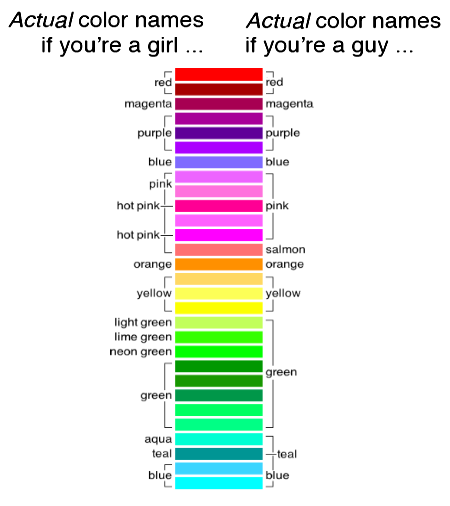
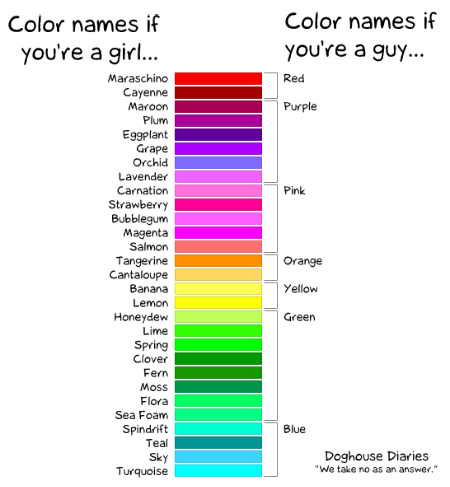
By a strange coincidence, the same night I first made the color survey public, the webcomic Doghouse Diaries put up this comic (which I altered slightly to fit in this blog, click for original):

It was funny, but I realized I could test whether it was accurate (as far as chromosomal sex goes, anyway, which we asked about because it’s tied to colorblindness) [Note: For more on this distinction, see my follow-up post]. After the survey closed, I generated a version of the Doghouse Diaries comic with actual data, using the most frequent color name for the handful of colors in the survey closest to the ones in the comic:

Basically, women were slightly more liberal with the modifiers, but otherwise they generally agreed (and some of the differences may be sampling noise).  The results were similar across the survey—men and women tended on average to call colors the same names.
So I was feeling pretty good about equality.  Then I decided to calculate the ‘most masculine’ and ‘most feminine’ colors.  I was looking for the color names most disproportionately popular among each group; that is, the names that the most women came up with compared to the fewest men (or vice versa).
Here are the color names most disproportionately popular among women:
  1. Dusty Teal
  2. Blush Pink
  3. Dusty Lavender
  4. Butter Yellow
  5. Dusky Rose
Okay, pretty flowery, certainly.  Kind of an incense-bomb-set-off-in-a-Bed-Bath-&-Beyond vibe.  Well, let’s take a look at the other list.
Here are the color names most disproportionately popular among men:
  1. Penis
  2. Gay
  3. WTF
  4. Dunno
  5. Baige
I … that’s not my typo in #5—the only actual color in the list really is a misspelling of “beige”.  And keep in mind, this is based on the number of unique people who answered the color, not the number of times they typed it.  This isn’t just the effect of a couple spammers. In fact, this is after the spamfilter.

The above is an excerpt from the blog http://blag.xkcd.com/

The author of the blog carried out a colour survey where the people surveyed were to name colours and gender differences in naming colours was discovered. I came across this blog post before i read Lakoff 's article and thought it was applicable to the discussion as well as interesting. While this survey is not of the academic sort, it does show that gender differences in usage of language is prevalent.

The above blog post not only emphasizes Lakoff's point on women making more precise discriminations, but also the higher likelihood for men to use expletives. In the above case, the people surveyed were made to name a very large number of colours that most of them became frustrated and many men resorted to vulgar language when they gave up naming colours.

I agree especially with the point on the differences in use of swear words by women and men. Men are more likely to use stronger swear words and expletives than women. Although this is changing in the modern society as Lakoff mentioned, I do feel that in the more conservative society in Singapore, many women still use weaker swear words than men. While women using stronger swear words are becoming more common, many male friends of mine have often mentioned that this is 'unladylike' or unbecoming of a woman. These females who are 'unladylike' due to their usage of stronger swear words are then less likely to attract conservative men as a partner. These men tend to look for women that are gentle and caring instead. While the usage of expletives or swear words doesn't necessarily make one less gentle and caring, it seems to conservative men that such women appear not to the 'traditional female' roles of caring and nurturing as well.

Food for thought:
Why is it considered more feminine to make more precise colour descriptions?
How does using stronger swear words come across as more masculine? Is it because it is more aggressive?
What other reactions would men have in response to a women using strong swear words in the workplace as compared to in other social settings?

Tuesday, January 18, 2011

Things you don't say to your wife


Here is a funny clip on the things you shouldn't say to your wife.

While searching for articles or video clips to post on this blog, I came across many articles explaining how women communicate to men and giving men advice on communication with women. Most articles and videos bring humour into the topic of gender miscommunication and make fun of the way women communicate, with a tendency to protray women as psychotic, emotional beings who never say what they mean. While this lightens up the mood on a serious topic, I do feel that these portrayals are a little extreme at times, although they are often true. As a female, I find these portrayals of women funny, but also alternate between feeling guilty of such 'crazy' behaviour and offended at the way women use communication is ridiculed.

I also find it interesting that much relationship advice on communication in the popular media always focuses on how men should be more caring and sensitive to what women really mean when they communicate. Personally, I feel that it takes two hands to clap, and that both genders should learn how to interpret each other and communicate such that the other gender can easily understand what they really mean.

About Me

Hello everybody :) Just a short introduction on myself. I'm a Year 3 Life Science major and i just returned from an exchange programme in London.

What attracted me to this module was the topic on miscommunication between men and women. I am interested in gender differences and the society and often wrote on this topic during my junior college days when we did general paper for 'A' Levels. I find that gender differences are pervasive in all societies and much of what i learn about gender can be applied to real life situations. I have already learnt from reading and discussing Tannen's article "Can't We Talk" and find myself applying what I learnt in everyday life. I look forward to learning more about gender miscommunication and in the process improve and hone my writing skills.